The sanctification of time (Part 1): The Eight Prayer Watches
Every hour belongs to God. Some hours help us remember.
“pray without ceasing.” - 1 Thessalonians 5:17
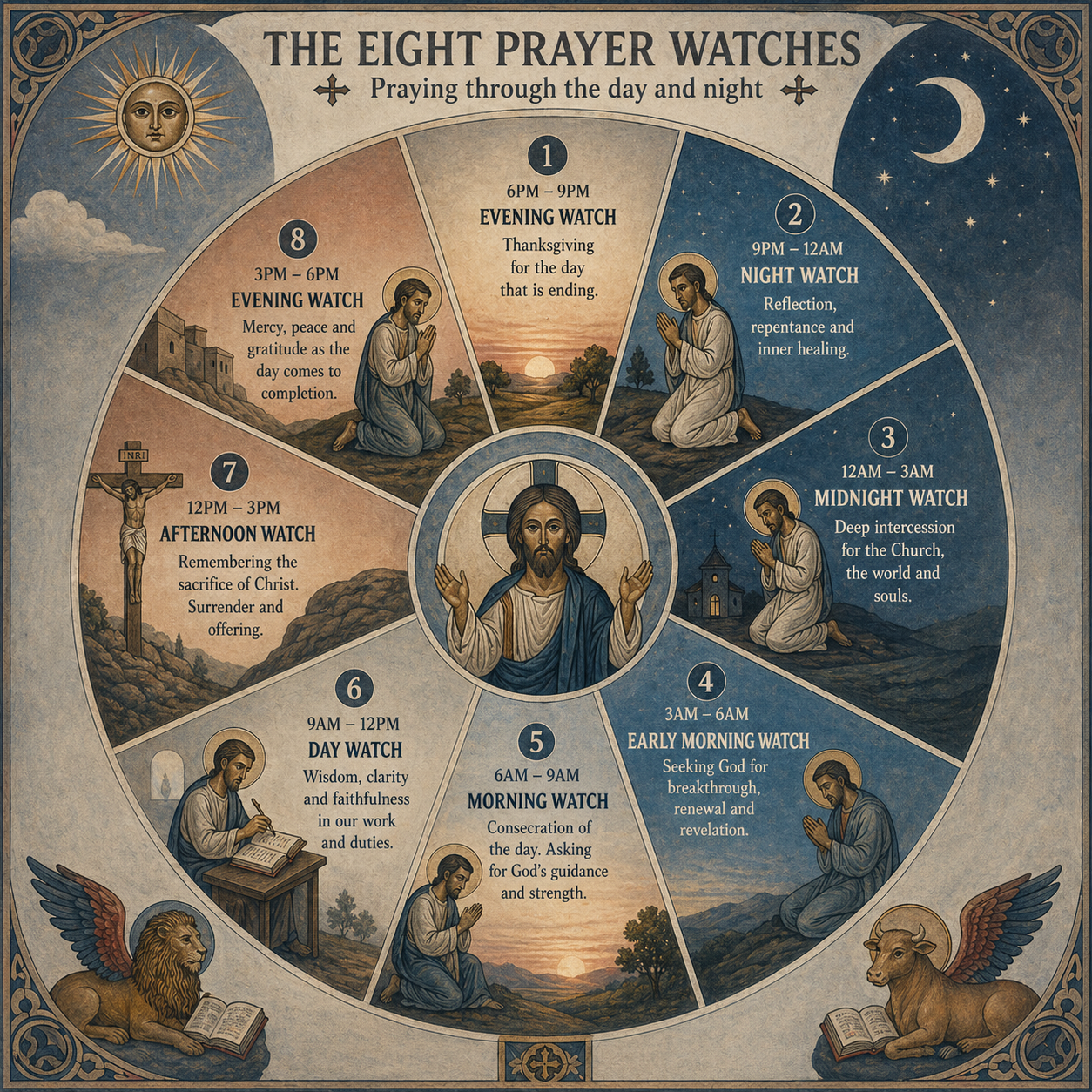
Across the major religious traditions, one finds a consistent intuition that:
Human life finds its proper orientation when it returns to God repeatedly throughout the day.
Time can be sanctified through rhythm.
Time itself becomes the setting of an ongoing dialogue between God and humanity.
This intuition is expressed through the deliberate structuring of the day around fixed moments of prayer, where specific hours are set apart and given over to remembrance, devotion, and return. Rather than leaving prayer to spontaneity or circumstance, these traditions recognize the wisdom of establishing regular intervals that anchor the human person in a continual relationship with God.
“Be always on the watch, and pray that you may be able to escape all that is about to happen, and that you may be able to stand before the Son of Man.””
The logic of this practice rests in the recognition that time shapes consciousness. As the day unfolds through its natural cycles (light and darkness, activity and rest), attention is continually drawn outward into tasks, responsibilities, and concerns. The establishment of fixed hours of prayer introduces a counter-movement, a repeated turning back, through which the human person reorients, recollects, and places the whole of life again in reference to God.
The benefits of such structuring become evident through its constancy. The repetition of prayer across the day stabilizes attention, disciplines memory, forms desire, so that awareness of God is no longer confined to isolated moments but becomes integrated into the fabric of daily life.
“At midnight I rise to give you thanks...Seven times a day I praise you for your righteous ordinances.”
Over time, this rhythm cultivates an interior continuity, where action, thought, and intention remain aligned with the presence of God across changing circumstances.
Across traditions, this pattern takes different forms, yet follows the same underlying wisdom:
the day is divided,
certain hours are consecrated,
and the human person is trained through faithful repetition to live in sustained relationship with God.
In Islam, the five daily prayers structure the day from dawn to night; in Judaism, the rhythm of morning, afternoon, and evening prayer develops from the life of the Temple; in Christianity, this inheritance continues and expands into ordered patterns of prayer that shape both personal devotion and communal worship.
1. the Origin of the Eight Prayer Watches
“And if he shall come in the second watch, or come in the third watch, and find them so, blessed are those servants.”
“And in the fourth watch of the night Jesus went unto them, walking on the sea.”
The practice of structuring prayer across the day and night takes different forms within Christianity, and one contemporary expression of this is known as the eight prayer watches. This framework organizes the 24 hours of the day into successive periods of 3 hours each dedicated to prayer. The intention is extending attentiveness to God across the full cycle of time.
“Watch and pray so that you will not fall into temptation. The spirit is willing, but the flesh is weak.”
The language of “watches” originates in Scripture, where the night is divided into periods of vigilance. These watches mark moments of alertness, readiness, and expectation, particularly in relation to God’s action. The biblical references establish this pattern:
““As the watches of the night begin; pour out your heart like water in the presence of the Lord. Lift up your hands to him.””
The origin of this system belongs to modern Christian prayer movements, particularly those that emphasize sustained intercession and continuous prayer. It is not tied to a single historic denomination, but found especially within:
Charismatic and Pentecostal traditions
Evangelical intercessory ministries
Global prayer movements emphasizing continuous prayer
These communities seek to ensure that prayer accompanies every hour of the day, and the eight-watch system serves as a practical framework to organize that commitment.
They are not part of the official liturgical systems of the Catholic Church, the Eastern Orthodox Churches, and classical Protestant liturgical traditions.
From a theological and historical perspective, it is important to locate this practice accurately:
The eight prayer watches belong to contemporary devotional practice
They are not part of the historic liturgical systems of the Church
They do not appear in early Christian writings or monastic rules
This distinction matters for theological clarity:
The eight watches function as a devotional tool or framework, rather than a formally transmitted tradition.
They do not carry the authority of established liturgical tradition, although the underlying theological principle that supports this practice is firmly rooted in Scripture. The repeated return to God throughout the day reflects a vision expressed clearly in the biblical texts:
“Seven times a day I praise you” — Psalms 119:164
“Pray without ceasing” — 1 Thessalonians 5:17
2. The Structure of the Eight Prayer Watches
The system of the eight prayer watches divides the twenty-four hours of the day into eight successive periods of three hours, beginning at sunset and continuing through the night into the following day. This structuring reflects an ancient understanding of the day that begins in the evening, a pattern already present in the creation account of Genesis, where each day is described as “evening and morning.”
What is often called “time gates” reflects the belief that certain hours carry particular spiritual openness or significance. The language of “gates” comes from Scripture, where gates symbolize:
Entry points
Authority
Transition between realms
Applied to time, “gates” suggests moments where heaven and earth are especially aligned for encounter.
The watches are commonly presented as follows:
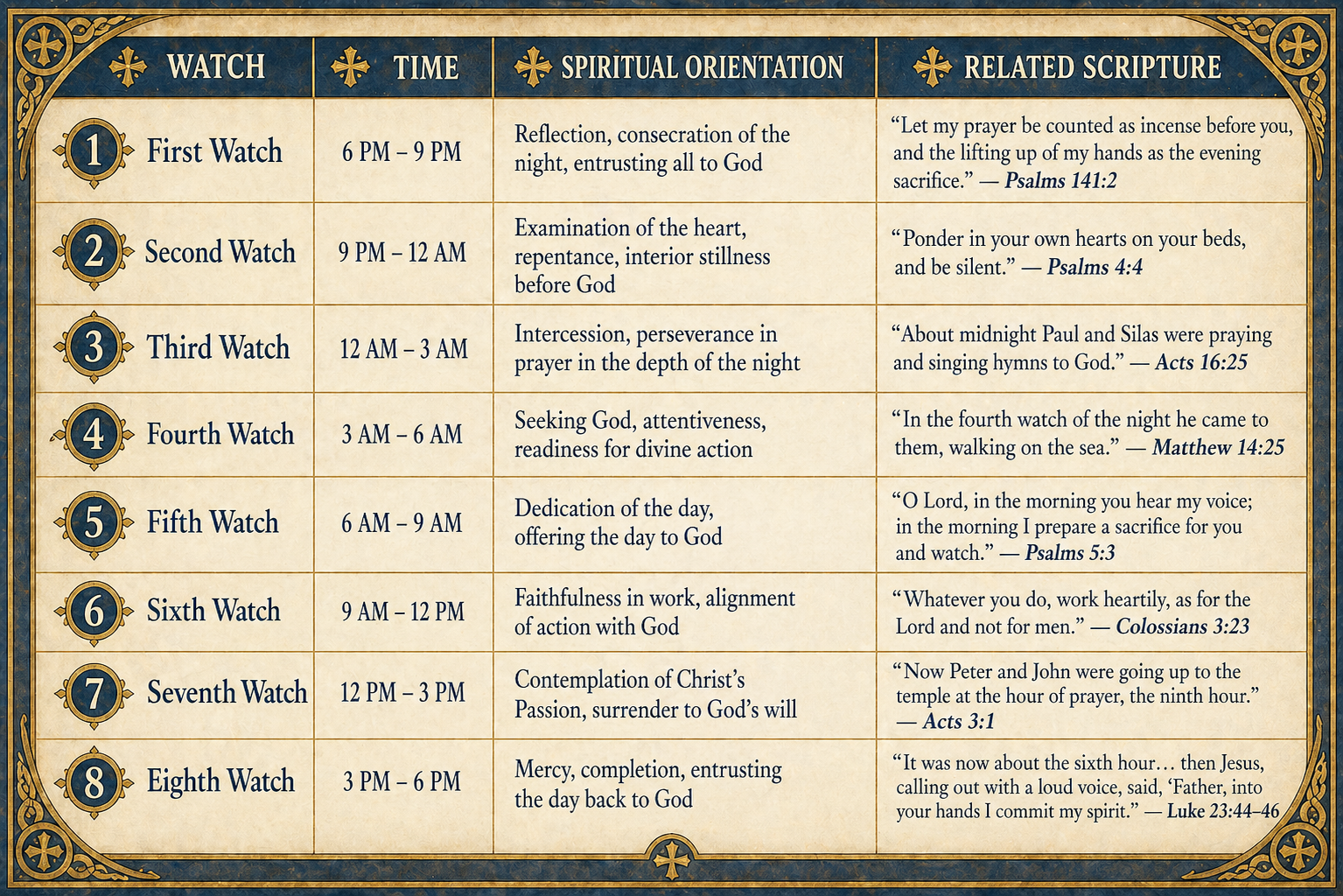
The thematic content assigned to each watch draws from key moments in Scripture that occur at particular times of day and from theological reflection on the life of Christ.
The midnight hours, associated with the third watch, recall the prayer of Paul and Silas in prison in Acts 16:25, a moment that has come to represent persevering intercession in darkness. The early morning hours evoke the pattern of Jesus withdrawing to pray before the beginning of the day, as described in Mark 1:35, which grounds the practice of seeking God at the threshold of daily activity. The ninth hour, corresponding to the seventh watch, carries the weight of the Passion, since it marks the hour of Christ’s death in Luke 23:44–46.
Through these associations, the watches become a way of entering into the rhythm of salvation history across the span of a single day, allowing the life of Christ to shape the temporal experience of the believer.
Note: This framework is interpretive and devotional, not prescriptive. It is important to be precise. Scripture affirms appointed times but does not explicitly teach that each 3-hour segment is a “spiritual portal”.
Some more biblical references:
“On my bed I remember you; I think of you through the watches of the night.” - Psalm 63:6
“During the last watch of the night the Lord looked down from the pillar of fire and cloud at the Egyptian army and threw it into confusion.” - Exodus 14:24
“My eyes stay open through the watches of the night” - Psalm 119:148
The watches and the hours are not rigid obligation. They are about training our body, mind, and soul to remain turned toward God across the entire arc of the day.
CAUTION:
As with every practice, it becomes meaningful when:
It deepens attentiveness
It anchors prayer into daily life
It aligns the heart with God’s presence throughout the day
It becomes problematic when:
It turns into superstition
It suggests God is only accessible at certain hours
It replaces relationship with technique