A conversation with a dear friend yesterday brought me back to a question I have been carrying for some time, and I bring it to this circle because so many of you know its territory better than most. You have spent years, some of you decades, in therapy, coaching, healing work and contemplative practice, and you have accompanied others through the same terrain. The question is whether all this attention to ourselves has shaped the way we see the people we love, to the point where every relationship becomes, almost without our noticing, a chapter in our own development. Sitting with it over the past months, I have come across a few insights along the way, and I share them with you as one practitioner to another.
What the inward turn gave us
Any honest reflection on this begins with gratitude. Carl Jung taught a whole century to recognize projection, the way we attribute to others what we have not yet acknowledged in ourselves, and to take responsibility for our shadow; he wrote that individuation gathers the world to oneself, so that self-knowledge was always meant to bring a person into fuller relationship. Attachment research helped us understand why some of us cling and others withdraw, and gave couples a shared language for patterns that once simply wounded them. Humanistic psychologists such as Carl Rogers and Abraham Maslow insisted that every person carries a capacity for growth. Through these traditions many people have found healing, freedom and renewed dignity, broken cycles inherited from their families, and learned to apologize, hold boundaries and speak honestly. Self-knowledge, rightly held, makes us better partners.
The difficulty arises when something good is extended beyond its proper reach. A tool designed to illuminate particular moments becomes a lens for every moment. Projection, which Jung used to explain specific and disproportionate reactions, becomes the conviction that everyone is my mirror. Growth, which Maslow in his late work understood as a path leading toward self-transcendence, becomes the purpose every relationship must serve. Each step along the way seems reasonable, which is why the movement is so hard to see from inside: it makes sense, we keep going, and at some point we find ourselves far from where we meant to be.
An insight found along the way: emotional capitalism
The most clarifying account of how this happened comes from the sociologist Eva Illouz, whose book Cold Intimacies: The Making of Emotional Capitalism began as her Adorno Lectures in Frankfurt in 2004. Illouz shows that capitalism has fostered an intensely emotional culture, in the workplace, in the family and in our relationship to ourselves, and that the influence runs both ways. Economic life has become deeply emotional, and intimate life has come to be organized by the models of bargaining, exchange and equity that originated in the market. She calls this double movement emotional capitalism.
Her history is worth knowing because we are its heirs. Illouz locates a turning point in Freud’s 1909 lectures at Clark University in Massachusetts, after which psychoanalytic ideas spread rapidly through an American culture already devoted to self-improvement, and she credits Freud, somewhat against his own intentions, with advancing a meritocratic and voluntarist narrative of self-help. In the 1920s and 1930s industrial psychologists, Elton Mayo foremost among them, persuaded managers that productivity depended on workers’ feelings, and communication became the master model of the modern corporation, with its listening skills, empathy, emotional self-control and conflict management. Rogers and Maslow then taught that every human being strives naturally toward self-realization, which extended the psychologist’s domain from illness to the whole of life. The same vocabulary entered the couple. Illouz argues that therapeutic and feminist discourses, each pursuing real goods such as equality and mutual recognition, together taught us to treat emotions as objects we can separate from ourselves, name, measure, discuss and negotiate. Intimacy became a project managed through communication, and the relationship itself became something to evaluate.
Two further observations in her work struck me most. The first is that emotional skill has become a form of capital: the capacity to identify, express and regulate feelings, popularized as emotional intelligence, confers status and advantage at work and in love, and those who hold it learn to read relationships in terms of competence and return. The second concerns what she calls the self-realization narrative. Because this story organizes a life around a movement from dysfunction toward health, and because a fully realized self has no fixed endpoint, the narrative keeps generating new dysfunctions to work on. Suffering moves to the centre of identity, and the story of the self becomes an unending story of repair. The sociologist Philip Rieff had already observed in the 1960s that self-realization, once the fruit of commitment to a shared purpose, was becoming an end pursued for its own sake. Illouz shows how that end found its way into our most intimate bonds.
Where it takes our relationships
Once I understood this history, I began to hear its traces in the way many of us, myself included, speak about love. Each of the four patterns that follow begins as something healthy, and each becomes distorting when it is carried too far.
The partner becomes a mirror
The relationship becomes a ledger
The wound that never closes
Analysis takes the place of presence
(1) The partner becomes a mirror
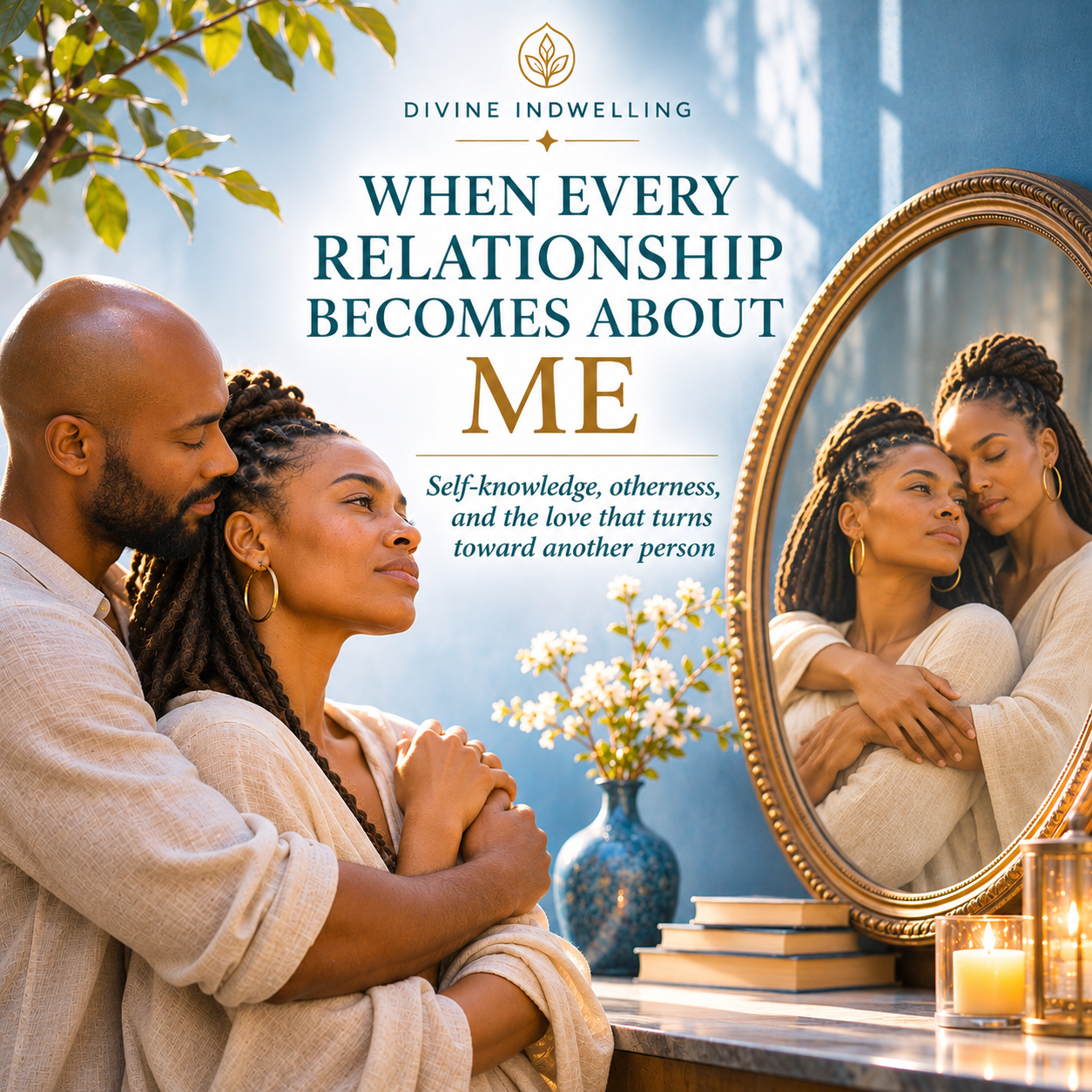
Noticing projection is a mature skill, and it can save a relationship from a great deal of blame. Carried too far, it turns every word and mood of the other person into information about me: his withdrawal reveals my abandonment wound, her criticism shows what I have not yet healed, his arrival in my life was assigned to my evolution. The philosopher Byung-Chul Han describes this condition in The Agony of Eros, where he argues that in a narcissistic culture the other person is “robOnce I understood this history, I began to hear its traces in the way many of us, myself included, speak about love. Each of the four patterns that follow begins as something healthy, and each becomes distorting when it is carried too far.
bed of otherness and degrades into a mirror.” The cost falls on the one being mirrored. Their history, fears, desires and relationship with God recede from view, and they experience being studied in place of being met. Their sadness becomes my trigger, and their suffering becomes material for my transformation.
(2) The relationship becomes a ledger
Naming needs, sharing burdens fairly and refusing exploitation are real achievements of modern intimacy. Carried too far, they install the market at the heart of the home. The relationship is audited continuously for whether it still serves my growth, whether my needs are met in proportion to what I give, whether this partner remains the best available option. Illouz traces how this logic, intensified by the abundance of choice that dating apps now offer, makes commitment harder to sustain. The ledger has no column for the seasons every marriage contains, when one person is ill, grieving or depleted and the other carries them, or for the generosity that gives without counting. Love that must keep justifying itself by its returns becomes fragile, and the exit always seems close.
(3) The wound that never closes
Healing what was broken in childhood is holy work. Carried too far, and joined to the self-realization narrative, it leaves a person permanently in preparation, with one more pattern to uncover and one more wound to heal before they are ready to love or worthy of being loved. Manifestation teaching adds a further turn: if I attract what I vibrate, then the love I receive becomes a measure of how healed I am. The psychologist Melvin Lerner documented how strongly people need to believe that the world is just, so much so that observers in his studies thought less of innocent sufferers they could not help. Spiritualized, this belief reads every disappointment in love as proof of personal insufficiency, and it places on the individual a weight that belongs partly to other people’s freedom and partly to God.
(4) Analysis takes the place of presence
Understanding our reactions helps us respond with care. Carried too far, interpretation becomes the reflex that stands between us and life as it happens. A disagreement about money becomes an attachment dynamic, a partner’s poor decision becomes a lesson the universe intended, and an ordinary bad day becomes a case study. The responses these moments call for, listening, apologizing, forgiving, laughing, waiting, grow harder to offer because each must first pass through an analysis of ourselves. This is the coldness Illouz names in her title: relationships that are articulated, examined and managed with great skill, and that slowly lose their warmth.
Grace, the gift no market can explain
The Christian tradition holds a reality that sits entirely outside the logic of exchange, and its name is grace. The Greek charis means gift, favour freely given. Paul writes that God proves his love for us in that while we were still sinners Christ died for us (Romans 5:8), and that we are saved by grace as the gift of God, so that no one may boast (Ephesians 2:8–9). Grace arrives before any healing is complete, before we are aligned, before we have earned anything. In the vocabulary of emotional capitalism it is a transfer with no return expected, which makes it unintelligible within that economy and liberating for anyone caught inside it. If God loves me before I am healed, then love can stop being the reward for my inner work, and I am released from the endless audit of whether I am ready to love or worthy of being loved. “We love because he first loved us” (1 John 4:19).
Grace also changes how I see the other person. Dietrich Bonhoeffer, writing in Life Together (1939), distinguished self-centred love, which loves the other for its own sake, from spiritual love, which loves the other for the sake of Christ. Because Christ stands between me and others, Bonhoeffer wrote, I must release the other person from every attempt of mine to regulate, coerce and dominate them with my love. God made other people in God’s own image and in their freedom from me (Genesis 1:27), which leaves me no mandate to mold them into an image that seems good to me. Bonhoeffer also warned against loving our dream of a community more than the community itself, and the same holds in marriage, where the idealized partner I have constructed can stand between me and the real person God has given me. Grace allows me to receive that real person as a gift.
Paul offers an image that completes this movement. Love, he writes, does not seek its own (1 Corinthians 13:5), and he describes its fulfilment as a passage from seeing “in a mirror, dimly” to seeing “face to face” (13:12). The mirror belongs to partial knowledge, and love moves toward the face of the other.
Bringing it home
In daily life, grace turns our attention outward. When my husband reacts differently from how I would, I can become curious about his experience before I ask what it reveals about me; his sadness can remain his, his aspirations matter because they matter to him, and his life with God unfolds according to the way God is leading him. Iris Murdoch described love as “the extremely difficult realisation that something other than oneself is real,” and that realisation is a discipline we can practise. Intercessory prayer may be its purest form. Bonhoeffer called intercession the most promising way to reach our neighbours, because in it we bring another person before God for their own sake and ask for their good, including good we will never see and from which we will never benefit. For those in this circle praying for a future husband, the same prayer can be offered for a man whose name we do not yet know, for his peace, his health and his life with God, as an act of love complete in itself.
The work we have done on ourselves remains a gift, and it reaches its fulfilment when it frees us to attend to someone else. The next stage of our maturity may be a growing freedom from our own development as the subject of every experience, so that a relationship can sometimes simply be the place where we love.
FOR PRAYER & REFLECTION
Which of the four patterns do I recognize most readily in the way I speak about my relationships?
Where has self-awareness helped me love more freely, and where has it become a way of managing uncertainty or keeping score?
Whom have I been interpreting mainly through the lens of my own story, and what would change if I became curious about theirs?
Am I waiting to be healed enough before I allow myself to love or to be loved?
What would it mean this week to receive one person as a gift of grace, beyond any role they play in my growth?
In prayer, what might God want me to see about this person that I have not yet been willing to recognize?
-
Bonhoeffer, Dietrich. Life Together (Gemeinsames Leben, 1939).
Han, Byung-Chul. The Agony of Eros. Trans. Erik Butler. Cambridge, MA: MIT Press, 2017.
Illouz, Eva. Cold Intimacies: The Making of Emotional Capitalism. Cambridge: Polity, 2007.
Illouz, Eva. Saving the Modern Soul: Therapy, Emotions, and the Culture of Self-Help. Berkeley: University of California Press, 2008.
Illouz, Eva. Why Love Hurts: A Sociological Explanation. Cambridge: Polity, 2012.
Lerner, Melvin J. The Belief in a Just World: A Fundamental Delusion. New York: Plenum, 1980.
Murdoch, Iris. “The Sublime and the Good.” Chicago Review 13 (1959).
Rieff, Philip. The Triumph of the Therapeutic. New York: Harper & Row, 1966.
Scripture: Genesis 1:27; Romans 5:8; Ephesians 2:8–9; 1 Corinthians 13:5, 12; 1 John 4:19.