What if our longing for love and companionship originates in God's own desire for humanity?
The story of Adam and Eve offers a profound insight into the place of relationship within the divine design of creation. Before Adam expresses any need for companionship, God declares that it is not good for the human to be alone. Through this ancient story, we explore the sacred origins of our longing for partnership and how this natural desire can become entangled with fear, shame, and expectations about who we should be or where we should be in life. This reflection invites us to rediscover the goodness of longing and cultivate a more peaceful relationship with our desire to love and be loved.
““And the Lord God said, “It is not good that man should be alone; I will make him a helper comparable to him.”
And the Lord God caused a deep sleep to fall on Adam, and he slept; and He took one of his ribs, and closed up the flesh in its place. Then the rib which the Lord God had taken from man He made into a woman, and He brought her to the man.
And Adam said:
“This is now bone of my bones
And flesh of my flesh;
She shall be called Woman,
Because she was taken out of Man.”””
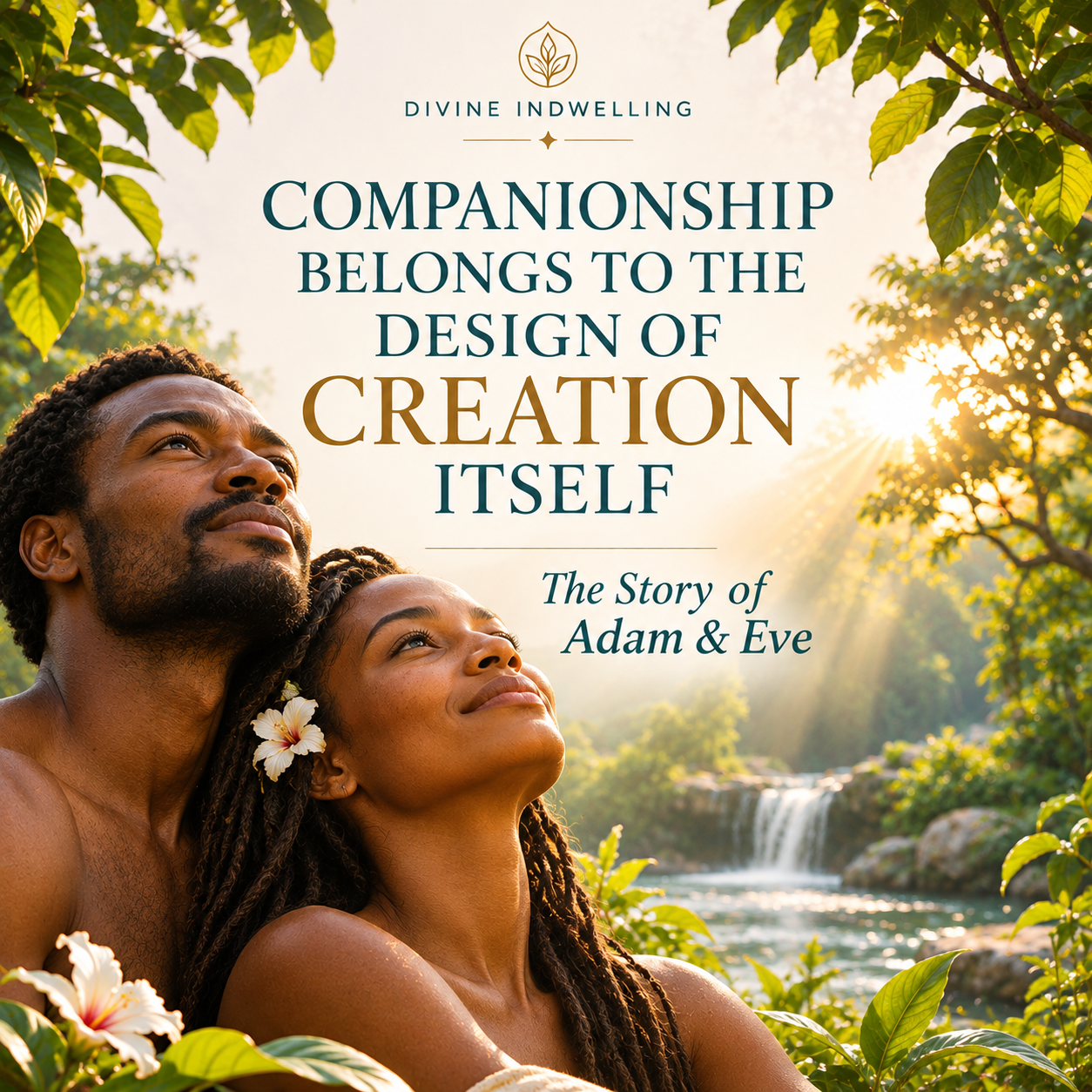
The story of Adam & Eve
In the beginning, according to the book of Genesis, God creates the world through a sequence of days.
Light and darkness come into being. The sky and the waters are separated. Land appears, and with it vegetation. The sun, moon, and stars are set in the heavens. Living creatures fill the seas, the skies, and the earth.
On the sixth day, God creates the human, formed from the dust of the ground. God breathes into the human’s nostrils the breath of life, and the human becomes a living being. This human is named Adam.
God places Adam in a garden and gives him responsibility for it. The garden is already full of life: trees, plants, rivers, and animals of every kind. Adam names the animals as they are brought before him. On the seventh day, God rests from the work of creation.
After this, God observes that it is not good for the human to be alone. None of the animals are found to be a suitable companion for him.
God then causes the human to fall into a deep sleep. While Adam sleeps, God takes one of his ribs and closes up the place with flesh. From the rib that was taken from Adam, God forms a woman and brings her to the man. When Adam sees her, he recognizes her as one who is like him, made from the same substance. The woman is named Eve.
-
The name Adam comes from Biblical Hebrew, the language in which Genesis was originally written.
In Hebrew:
אָדָם (’ādām) means human or human being
אֲדָמָה (’ădāmāh) means ground, soil, or earth
These two words come from the same root (’dm), which is associated with earthiness and, by extension, the reddish-brown color of soil.
So when Genesis says that the human is formed from the dust of the ground, the language itself is doing the theology:
The ’ādām is formed from the ’ădāmāh.
In other words, Adam is not initially a personal name in the modern sense. It is a wordplay that literally means the human made from the earth.
In the earliest layers of Genesis:
“Adam” functions as a collective and archetypal term, meaning the human
It is not immediately a proper name like “John” or “David”
The text often says ha-adam (הָאָדָם), which means “the human”, not “Adam” as an individual
Only later in the narrative does Adam begin to function more clearly as a personal name, once relational distinctions appear (man and woman, lineage, descendants).
So in the earliest sense:
Adam represents humanity itself
He is every human, not only a specific individual
By naming the human “Adam,” the text is making a profound claim:
Human beings are earth-born
They belong to the soil, the land, the material world
There is no separation between spirituality and embodiment at the beginning of the story
At the same time, the human is animated by divine breath. The story holds together:
earth (matter, finitude, vulnerability)
breath (life, spirit, consciousness)
The name Adam itself carries this tension and unity.
-
The name Eve comes from Biblical Hebrew, the language of Genesis.
In Hebrew, Eve’s name is חַוָּה (Chavah / Ḥawwāh).
The text itself explains her name:
“The man named his wife Eve, because she was the mother of all the living.”
(Genesis 3:20)The name Chavah is closely related to the Hebrew verb חיה (ḥayah), which means to live, to be alive, or to give life.
So Eve’s name is not arbitrary. It is directly tied to life itself.
At its root, Eve’s name carries the meaning:
Life
Living one
Source of life
Life-giver
Just as Adam is named in relation to the earth (adamah), Eve is named in relation to life (ḥayah).
Together, their names form a complete picture:
Adam: the human formed from the earth
Eve: the one associated with life, vitality, and continuation
Her name does not first define her by relationship to a man, but by her relationship to life itself.
As with Adam, the name functions symbolically before it functions personally.
In the early layers of the text:
Eve represents more than an individual woman
She embodies the principle of life, continuity, and generativity
She stands for the living future of humanity
Only later, as the narrative becomes more genealogical, does Eve function primarily as a personal name within a family lineage.
The naming of Eve reveals how the Genesis story understands womanhood at its origin. She is associated with life, vitality, and emergence. Her name places her at the heart of human continuation, not as an accessory to man, but as a bearer of life itself.
In the same way that Adam’s name tells us where humanity comes from, Eve’s name tells us what humanity is oriented toward.
What this story reveals
1. Where we are today
In contemporary society, our relationship to partnership has become increasingly complex. For many people, especially women, naming a desire for partnership carries emotional weight. Longing is shaped by cultural expectations, social narratives, and personal histories that influence how it is understood and experienced.
In some contexts, longing for partnership is questioned or diminished, particularly for women who are independent, accomplished, or self-sufficient. Desire can feel exposed, as though wanting shared life requires explanation or justification.
In other contexts, longing becomes intense and charged, shaped by pressure, comparison, or fear of being left behind. For those who are not partnered, the absence of relationship can turn inward, becoming a source of self-questioning or self-judgment.
These dynamics create an interior tension. Longing is present, yet it is rarely at ease. It is often accompanied by narratives about timing, worth, readiness, or personal failure. Over time, what begins as a natural desire for companionship can become a place of anxiety or emotional strain.
-
Our relationship to partnership is rarely neutral. It is shaped by personal history, cultural narratives, spiritual interpretations, and collective expectations. For many people, especially those who are not currently partnered, this area can become deeply tender and emotionally charged.
Below are some of the most common ways people relate to partnership internally. These are not categories to label oneself with, but patterns that often emerge over time.
1. Partnership as proof of worth
For some, being in a relationship becomes tied to a sense of personal value. Partnership is unconsciously experienced as evidence of being lovable, chosen, or “enough.”
When partnership is absent, the inner dialogue can turn punitive:
What is wrong with me?
Why am I not chosen?
If I were more lovable, this would have happened by now.
This posture often carries a sense of being judged by life itself, as though relationship status were a moral or spiritual verdict. Over time, this can lead to shame, self-doubt, and a feeling of being fundamentally lacking.
2. Partnership as punishment or withholding
Another common experience, especially among spiritually engaged people, is the sense that partnership is being withheld for a reason. This can take the form of feeling punished, tested, or delayed by God, life, or fate.
People in this posture may wonder:
What lesson am I failing to learn?
What must I fix before love is allowed to arrive?
Is my desire itself a problem?
Here, longing becomes painful not because of absence alone, but because it is interpreted as a sign of deficiency or spiritual immaturity.
3. Partnership as identity Expectation
Culturally and socially, partnership is often presented as a marker of adulthood, stability, and success. Being married or partnered can unconsciously become part of how a “complete life” is defined.
Those who are not partnered may feel subtly out of sync with their peers, excluded from social structures, or invisible in conversations oriented around couples and families. This experience is often compounded by age, gender expectations, and cultural norms.
The absence of partnership then carries not only personal longing, but social displacement.
4. Partnership as threat to autonomy
For others, partnership is associated with loss of freedom, compromise of self, or repetition of unhealthy relational patterns. This can be especially true for people who have experienced control, abandonment, or emotional inconsistency in past relationships.
Here, longing and fear coexist. Desire is present, but guarded. The nervous system may associate intimacy with danger, even when the heart still longs for connection.
This inner tension can create confusion and self-judgment: Why do I want this and resist it at the same time?
5. Partnership as idealized resolution
Some people carry an idealized image of partnership as the place where loneliness ends, wounds heal, and life finally settles. Love becomes imagined as the moment when everything falls into place.
While hope is natural, this posture can place enormous pressure on relationship itself. When partnership does not arrive, or when it fails to resolve deeper pain, disappointment can deepen into despair or cynicism.
6. Partnership as a neutral or chosen absence
There are also people for whom partnership is not central, or who experience seasons of single life as chosen, meaningful, or aligned with their current vocation. Even here, cultural assumptions can impose unnecessary questioning or explanation.
This posture, too, requires validation, as it often exists alongside external pressure to justify one’s life path.
Why this matters spiritually
When longing for partnership is interpreted through shame, punishment, fear, or social comparison, it becomes distorted. It is no longer simply a human desire, but a site of self-judgment.
2. What Scripture presents
The opening chapters of Genesis place relationship at the very beginning of human existence. Adam enters a world that is already formed and abundant. The earth, the garden, the animals, and the rhythms of nature are all present. Yet God observes that something essential remains incomplete. Companionship is named as part of human design, pointing toward mutuality, recognition, and shared interior life.
What is striking in this account is that the desire for companionship does not arise from the human.
Adam does not express loneliness or ask for another. The initiative comes entirely from God. It is God who sees that the human should not be alone. It is God who desires relationship for the human and acts on that desire. This places the longing for companionship within divine intention itself. Relationship is not first a human wish; it is something God wants for humanity.
The creation of woman follows in a distinctive way. Rather than being formed from the earth, the human is placed into a deep sleep. In this state of rest and receptivity, a rib is taken from Adam’s side, and from it the woman, Eve, is formed. The rib comes from the side of the body, near the heart and beneath the arm, a place associated with closeness, protection, and shared life. The ribcage shelters the lungs and the heart, organs connected to breath, emotion, and vitality. From this place, companionship takes shape as something intimate and essential to human life.
The language of the text emphasizes recognition and shared substance. Adam names the other as “bone of my bones, flesh of my flesh,” expressing kinship and belonging. Relationship emerges as something drawn from within human being itself.
Read archetypally, this story presents relationality as woven into the fabric of creation. The longing for partnership is present at the origin of the human story and carries a divine imprint. It begins with God’s own desire that the human live in relationship and companionship.
3. The Teaching: Longing as peaceful and human
When longing for partnership is filtered through shame, fear, or social comparison, it becomes distorted and turns into a place of self-judgment. This is why beginning with the story of Adam and Eve matters so deeply. The creation narrative places relational longing before moralization and evaluation. It names companionship as part of human design.
From this perspective, being without a partner is not a verdict on one’s worth, maturity, or spiritual standing. It is a lived circumstance, not an identity or a judgment.
What this story invites us to remember is that the longing for relationship belongs to creation itself. It is woven into how we are made. From the beginning, the human is not designed to walk alone. The desire for partnership is a natural expression of being human.
One of the most helpful ways to understand this longing is to think of it as breath.
Breathing happens because we are alive. What matters is the quality of the breath. When breathing is steady, the body feels regulated and at ease. When breathing becomes rushed or tense, the body begins to struggle.
Longing functions in much the same way. The question is not whether the longing for relationship should exist. The longing is already present. What we are invited to notice is how we are carrying it. Is it held with tension or pressure, or is it allowed to move naturally within us?
When longing is carried with anxiety, it becomes overwhelming. When it is carried with shame, it becomes constricting. What this story invites is a posture in which longing is allowed to be present in a peaceful and steady way.
Just as the body knows how to breathe when it is not interfered with, the heart knows how to long when it is not burdened by fear or guilt. Longing held in this way does not need to rush ahead of life, and it does not need to disappear for us to feel whole.
This is the balance the story points toward. Longing for relationship is as natural as breath. The work is to allow it to find its right rhythm within us.
Reflection & Journaling Prompt
The invitation today is not to resolve longing, eliminate desire, or promise outcomes. It is to reorient the inner relationship to longing itself.
Longing can be held without shame.
Absence does not mean failure.
Desire does not imply deficiency.
Partnership, when it comes, is not a measure of worth, and its absence is not a punishment. It is one dimension of human life among many, shaped by timing, circumstance, choice, and mystery.
Reflection questions:
How does longing for partnership show up in me right now?
When I notice this longing, what emotions tend to accompany it?
In what moments does my longing feel at ease, and in what moments does it feel strained?
What meanings have I attached to being partnered or not partnered?
Are there ways I judge myself around this desire?
What might it look like to allow this longing to exist without needing to resolve it today?
A Prayer of Reorientation
God of life, Source of my being, I come to You as I am.
I recognize that the longing for relationship did not begin in us. It was placed within us by You, woven into us from the beginning. I ask for Your grace to touch every place where this longing has become strained, shaped by fear, disappointment, or comparison. Restore in me the original posture of longing, as it was when humanity was first formed.
I remember that it was You who desired relationship, who said it was not good for the human to be alone, and who placed within us the capacity to long, to recognize, and to love. I place my longing back into Your hands. Help me to hold it peacefully, allowing it to breathe within me as You intended from the beginning.
Amen.