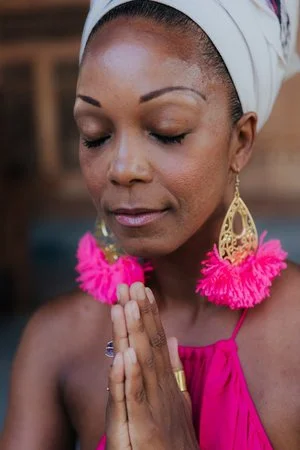
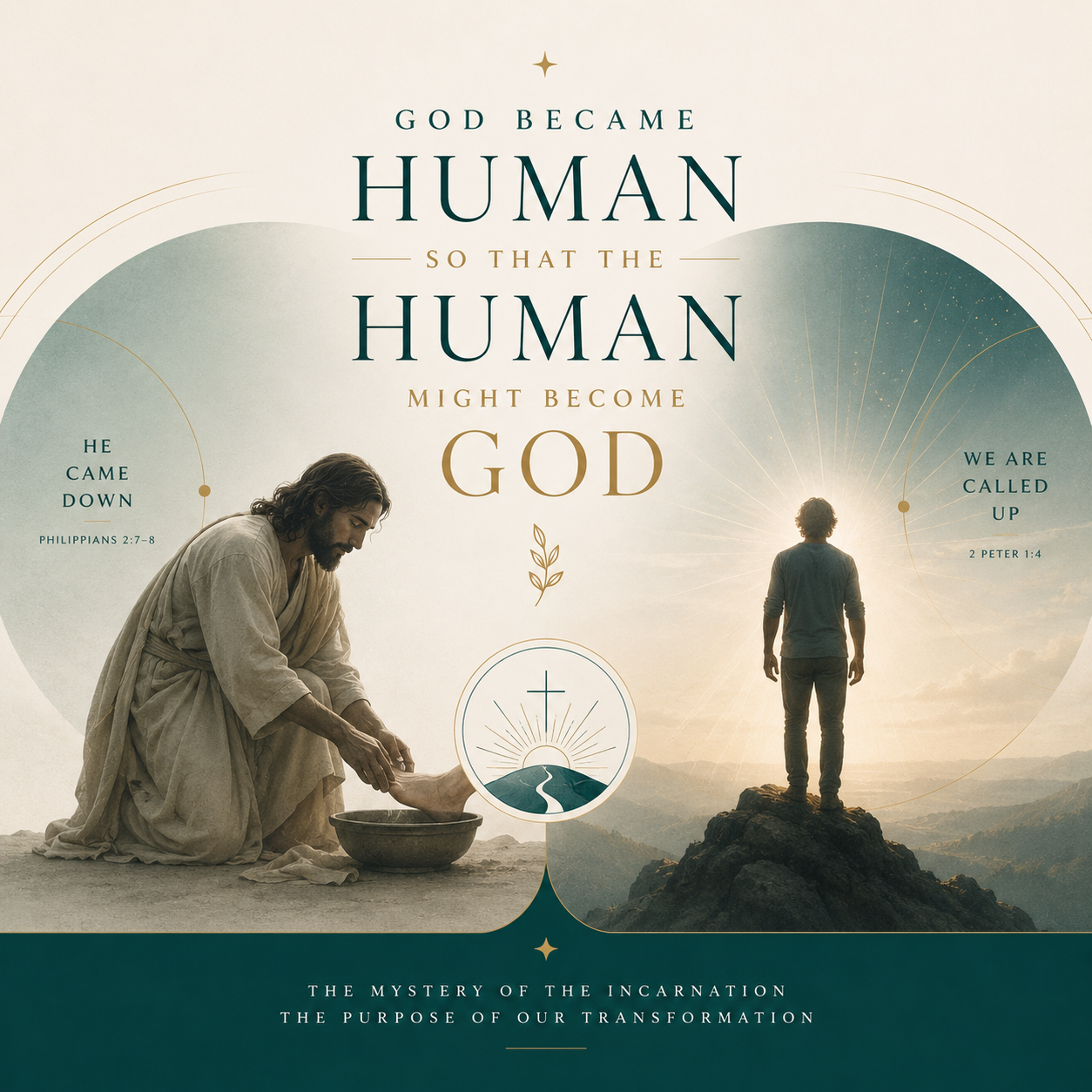
“God became human so that the human might become God”
Quote attributed to St. Athanasius of Alexandria
“In the beginning was the Word, and the Word was with God, and the Word was God.
He was with God in the beginning.
Through him all things were made; without him nothing was made that has been made.
In him was life, and that life was the light of all mankind. The light shines in the darkness, and the darkness has not overcome it...
The true light that gives light to everyone was coming into the world.
He was in the world, and though the world was made through him, the world did not recognize him.
He came to that which was his own, but his own did not receive him. Yet to all who did receive him, to those who believed in his name, he gave the right to become children of God, children born not of natural descent, nor of human decision or a husband’s will, but born of God.
The Word became flesh and made his dwelling among us.”
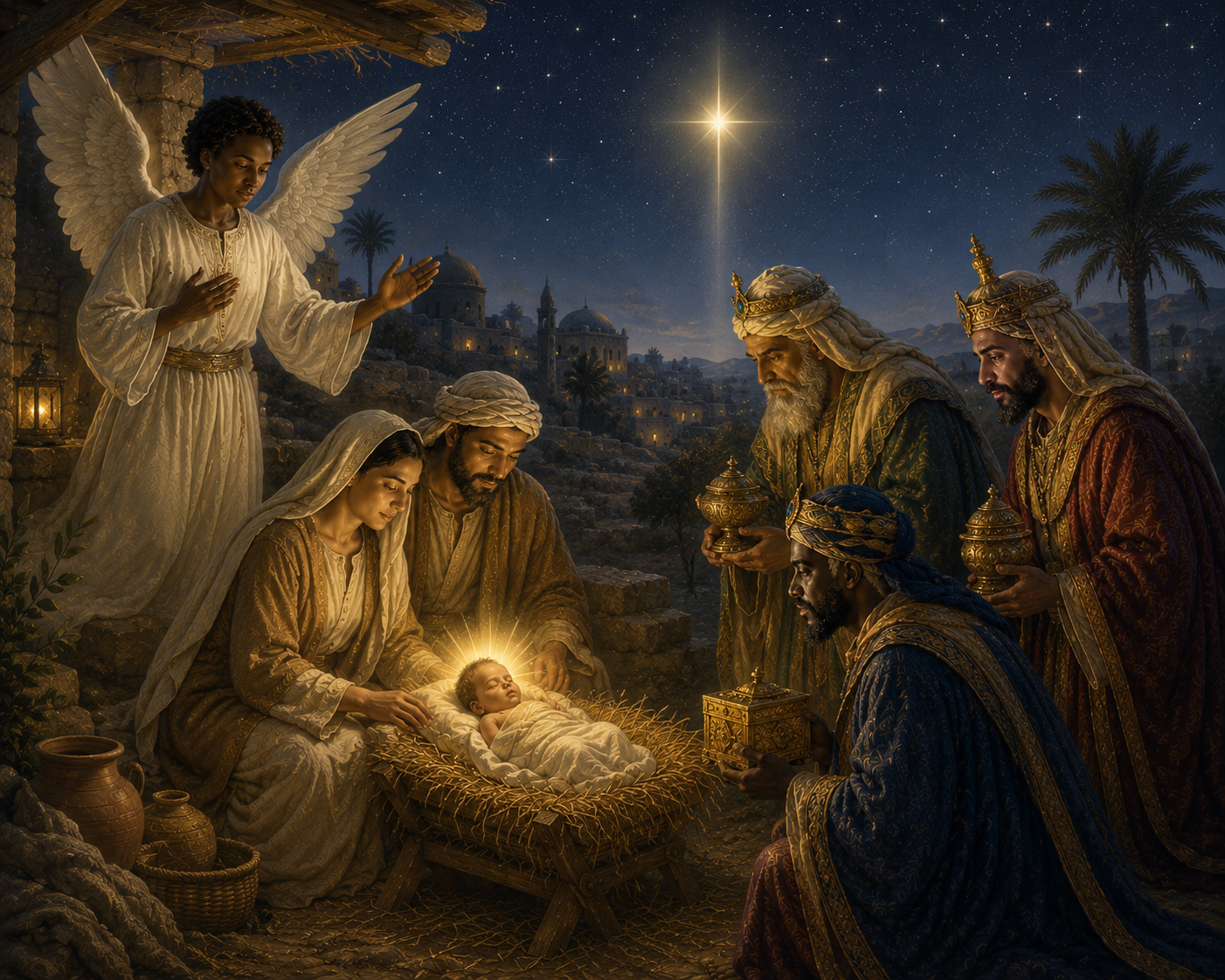
“While they were there, the time came for the baby to be born, and she gave birth to her firstborn, a son. She wrapped him in cloths and placed him in a manger, because there was no guest room available for them.
And there were shepherds living out in the fields nearby, keeping watch over their flocks at night. An angel of the Lord appeared to them, and the glory of the Lord shone around them, and they were terrified. But the angel said to them, “Do not be afraid. I bring you good news that will cause great joy for all the people. Today in the town of David a Savior has been born to you; he is the Messiah, the Lord. ”
Christmas is an interesting time. Like so many things that have endured across centuries, it is a multi-layered moment. It began as a religious ceremony in the 4th century, a liturgical celebration centered on the mystery of the Incarnation. Over time, it became a Christian tradition of family gatherings, shared meals, prayer, and remembrance. Later, it widened into a global end-of-year celebration, a time marked by gifts, reunions, and a collective pause. And then it evolved again.
Christmas became a vast cultural and consumer event, full of lights, shopping, excess, and expectation. For some, this brings togetherness, joy, beauty, and warmth. For others, it amplifies loneliness, longing for connection, the feeling of not belonging, the ache of absence, and the awareness of lack. It highlights broken relationships, fractured families, economic precarity, and griefs that are easier to ignore during the rest of the year.
In this way, Christmas celebrates what is whole while also exposing what is not. It gathers together joy and pain, abundance and lack, belonging and loneliness. It becomes a mirror of our societies and of our inner worlds.
Precisely because of this, Christmas carries spiritual depth. It is layered, complex, and paradoxical. And perhaps that is why, if we want to truly touch its spiritual mystery, we cannot remain at the surface of its expressions. We have to return to the most essential question:
what exactly is it that we are celebrating when we celebrate Christmas?
Only from there can the deeper meaning begin to unfold…
The origins of Christmas
The word Christmas comes from the Old English Crīstesmæsse, meaning Christ’s Mass. In Christianity, Christ is a title given to Jesus. You can read more about Jesus here.
Christmas originally referred to a specific ceremony: a communal prayer gathering held to honor Christ and to remember his coming into human life.
In Christian tradition, a Mass is a structured gathering of the community. People come together to listen to sacred texts, to pray, to sing, and to reflect collectively on the meaning of those texts for their lives. It is a shared spiritual practice shaped by rhythm, silence, spoken words, and symbolic actions, designed to help participants enter more deeply into what is being remembered.
Christmas, at its origin, named the Mass dedicated to a particular mystery: the Incarnation.This is the Christian belief that God enters human life and chooses to dwell within humanity. This mystery is contemplated through the story of the Nativity, the historical birth of Jesus.
This Christ’s Mass took place inside the church. It was quiet, contained, and centered on collective reflection. Its purpose was to gather people around a moment of theological depth, to attend together to a mystery that came to shape the heart of the Christian faith.
This was the original meaning of Christmas. It referred specifically to this gathering. It named a ceremony of remembrance and contemplation, grounded in a shared spiritual practice, focused on the profound idea of divine life entering human existence.
-
Understanding the evolution of Christmas allows less judgment and more discernment.
1. 4th–5th Century: A liturgical moment
Christmas begins as a specific Mass, celebrated inside the church. The experience is quiet, inward, and theological.
2. Late Antiquity–Early Middle Ages: The feast expands
As Christianity becomes more established in society, feasts begin to extend beyond the liturgy. The Mass remains central, but the day surrounding it gradually takes on importance. Fasting before Christmas becomes common. Feasting after the Mass enters daily life. The sacred moment slowly becomes a sacred day.
3. Medieval period: Christmas enters the home and village
During the Middle Ages, Christmas becomes a communal feast, a time of hospitality, a moment of social reversal and generosity. At this stage, Christmas moves from church into homes.
4. Early modern period: cultural layers accumulate
As Europe undergoes political, economic, and religious shifts, Christmas customs diversify by region, folk traditions merge with religious ones, gift-giving becomes more common. The feast absorbs cultural symbols and practices, while still retaining religious significance for many communities.
5. 19th Century: The birth of “modern Christmas”
The modern image of Christmas takes shape during the Victorian era: the family becomes central, childhood is idealized, generosity and sentiment are emphasized. Christmas becomes deeply domestic and emotional. The feast is now associated with home, warmth, moral goodness, social responsibility. This period creates much of what we now recognize as “traditional Christmas.”
6. 20th Century–present: Globalization and consumer culture
With industrialization, mass media, and global capitalism, Christmas spreads worldwide, religious boundaries soften, commercial elements intensify. Christmas becomes a cultural event, an economic season, a shared global moment.
Beyond Dogma, Toward Living Meaning
Approaching Christmas often brings us quickly into questions of belief. Was Jesus the Son of God? Did the Nativity unfold exactly as the texts describe? Are these accounts historically precise? These questions have shaped centuries of theology and debate, and for many people they remain important. At the same time, they can also narrow the way the mystery is received, keeping it at the level of agreement or disagreement rather than allowing it to work inwardly.
Sacred texts, especially when read contemplatively, point beyond themselves. They carry symbolic and spiritual meaning that speaks to universal human experience. They invite reflection on who we are, how consciousness moves through the world, and how life is transformed when deeper truth takes form within us. In this way, scripture functions less as a set of propositions to defend and more as a language that opens interior realities.
When Christmas is approached from this perspective, the focus naturally shifts away from proving what happened and toward exploring what the mystery reveals. Christmas becomes a mystery that does not separate believers from non-believers, but invites all who are willing to listen inwardly. This is where Christmas becomes universal. The question shifts from What must I believe? to What is this mystery awakening within me? From Who is right? to Who am I becoming?
When we loosen our grip on dogma, the Incarnation becomes a spiritual truth (also a mystery) that can be entered, contemplated, and lived, regardless of one’s religious background. In this light, the spiritual path is revealed as a path of transformation.
“God gives birth to His Son in the soul, and the soul gives birth to the Son in God.”
God enters the world: The divine indwelling
The Nativity can be approached as an archetypal story of divine consciousness entering matter.Interpreted this way, it speaks of a universal spiritual pattern that continues to unfold, a template, a way of understanding what it means to be fully human and fully alive.
When the Word becomes flesh, something is revealed about the nature of reality itself. It reveals something about consciousness, about human potential, about the relationship between the infinite and the embodied. If divine life can inhabit human form, then humanity itself carries a latent capacity for divinity.This is where the ancient Christian intuition arises: God became human so that the human might become God. This speaks of transformation. It points to an inner realization rather than an external assertion. It suggests that divine life seeks expression through form, through relationship, through lived experience. Divine consciousness enters the human condition. It takes on language, emotion, vulnerability, limitation, and time. It moves through a body, through relationships, through the ordinary textures of life.
This understanding shifts attention toward what is possible now. What does it mean for consciousness to descend into embodiment? What does it mean for love to take form through character, through choice, through the way one relates to others and to the world?
To realize that divine life dwells within is to accept a responsibility. It becomes a way of living in which qualities shape how one speaks, listens, responds, and acts. It points toward a spirituality rooted in inhabiting the human experience with greater depth and awareness. As Meister Eckhart says, the birth of God is not confined to history; it takes place continually in the soul. Divine life arises within the soul, and the soul participates in divine life. This expresses a mutual indwelling. Eckhart insists that this birth is not reserved for saints or mystics. It belongs to the true destiny of every human being.
The Way God enters matters as much as the fact that God enters
Christmas invites attention not only to the fact that God became human, but to the way that becoming unfolded. The manner of Jesus’ birth, the conditions surrounding it, the setting, and the people involved all carry meaning. In that how, there are also potent messages that feel particularly relevant in our time. There are many ways to approach the how of the Nativity. The scriptures do not offer a single lens or a closed interpretation. What follows is one way of listening to that how, one way of receiving what the story might be offering.
The Incarnation takes shape through the birth of a child, born to modest parents, in occupied territory, in economic precarity, at night, largely unseen. Night suggests interiority, silence, and a space where attention turns inward rather than outward. It hints at the way deeper transformations often arise beyond the gaze of others, in places where there is less performance and more listening. The divine takes root where there is room for stillness, where life is not constantly exposed or explained.
The Nativity unfolds in simplicity and precarity. There is no excess, no control over circumstances, no sense of mastery. The conditions are fragile, uncertain, and unfinished. And yet, it is within this vulnerability that divine life finds a home. This suggests that closeness to the divine does not require ideal conditions. It grows in places of openness, dependence, and trust. It finds its way into moments where certainty loosens and humility becomes possible.
The story also unfolds on the margins. Outside of homes, outside of institutions, outside of what is secure and established. This points toward a soil where the divine can take root: spaces that are not overfilled, not overdetermined, not closed by certainty. Inner landscapes that allow for receptivity, for surrender, for not knowing. Places where the human does not dominate life, but receives it.
Read this way, the Nativity becomes a reflection on the environments we cultivate within ourselves. What kind of inner soil do we offer for divine life to grow? What rhythms shape our days? What fills our attention? What conditions do we create through our choices, our pace, and our attachments? Does the way we live create space for the divine to take root? Do our environments, inner and outer, support depth, presence, and coherence?
The Nativity story remains rich and layered. It offers many points of entry and many hidden gems. It invites each person to linger, to listen, and to discover what this ancient story continues to reveal within their own life.
To allow divine life to take flesh in our character, in our choices, in our restraint, in our tenderness, in our fidelity to what is small, real, and entrusted to us, this is the invitation of Christmas.
To explore further
-
A recurring claim is that Christianity “stole” Christmas from pagan traditions. Even the language of stealing is divisive and flattens how religions actually develop. Religious traditions are layered, relational, and historically embedded. They grow through encounter, interpretation, and meaning-making, not through theft.
The earliest Christians did not celebrate Christmas at all. Their spiritual center was the Resurrection, not the Nativity. Easter shaped Christian time, prayer, and imagination, as the first generations lived in expectation of Christ’s imminent return. Christmas emerged much later, in the fourth century, particularly in Rome. The earliest clear record of its celebration on December 25 dates to 336 CE, at a moment when Christianity was moving from persecution into public life.
December 25 was chosen through theological reflection and cultural engagement, not by copying pagan rites. Christianity was forming its liturgical life within a Roman world already marked by winter festivals, symbols of light, and seasonal celebrations. That context mattered, but context is not the same as adoption. Christianity did not take over pagan myths or rituals. Rather, it articulated its own theological meaning within a shared cultural landscape.
Yes, December in the Roman world included festivals such as Dies Natalis Solis Invicti (the Birthday of the Unconquered Sun) and Saturnalia, with their emphasis on light, feasting, and gift-giving. But Christianity did not absorb the theology of these festivals. It proclaimed something entirely different: not the rebirth of the sun, but the Incarnation, God entering human history in vulnerability and flesh.
This kind of overlapping calendar is not unique to Christianity. Many religions share dates, symbols, or seasons while holding distinct meanings. Hindus and Sikhs both celebrate Diwali, yet each tradition understands the festival through its own theology and story. Shared timing does not erase difference; it highlights how human cultures mark meaning together while interpreting it differently.
It is also worth remembering that December 25 is not universal in Christianity. Orthodox and Oriental Orthodox traditions follow older calendars. In Ethiopian and Coptic traditions, Christmas "Genna” is celebrated on January 7. The Armenian Church, preserving one of the oldest Christian calendars, celebrates the Nativity on January 6, as do several Syriac and Assyrian communities. These variations remind us that Christmas was never a single, fixed invention but a living tradition shaped across cultures, calendars, and centuries.
To reduce this history to “Christianity stealing from paganism” is to miss the deeper truth: religions do not emerge in isolation. They speak into the worlds they inhabit, re-interpreting time, symbols, and seasons through their own sacred vision. Christmas is not a borrowed myth. It is a theological proclamation shaped in history, layered, embodied, and deeply human.
-
Genna is the Ethiopian Orthodox celebration of the Nativity of Christ, observed on January 7.
In the Ethiopian Orthodox Tewahedo Church, Genna is a hidden, inward, ascetical feast, quiet in tone, dense in theology, and inseparable from fasting, vigilance, and night prayer.
The Fast of the Prophets (Tsome Nebiyat): The 43-day fast before Genna is called the Fast of the Prophets. It begins on Hidar 15 (mid-November) and culminates with the Nativity. The Incarnation is understood as God entering flesh. The fast teaches that the body itself must learn how to receive God.
A nocturnal feast: The Nativity occurs in the night, both historically and theologically. So Genna is celebrated with an overnight vigil, extended chanting (zema), and the Divine Liturgy completed before dawn.
White garments and stillness: Faithful wear white shammas, symbolizing baptismal purity, resurrection light, and the simplicity of shepherds.
-
Across religious and spiritual traditions, there is a shared intuition that the sacred is not entirely removed from human life. Different traditions articulate this relationship in different ways, using distinct languages and symbols, yet many are grappling with a similar mystery: how does the Divine become present within the human world?
Christianity
In Christianity, the term Incarnation refers to the belief that the Divine Word takes flesh in a specific historical person. This is understood as a complete participation in human life, not simply a divine appearance. Divine life enters embodiment and remains united with humanity. The Incarnation carries both historical and existential meaning, shaping how Christians understand God, humanity, and transformation.
Hindu Traditions
In Hindu traditions, divine embodiment is understood through several overlapping frameworks, not only through the idea of avatars. While avatars describe moments when the Divine descends into the world in visible form, Hindu thought also speaks of divinity expressing itself through realized beings, sages, and teachers who embody divine qualities.
The Divine is understood as both transcendent and immanent. Ultimate reality (Brahman) permeates all existence, and human beings can realize their identity with this divine ground. Some figures are understood as particularly transparent expressions of divine consciousness, not always because they are “sent” in a singular sense, but because divine awareness has fully awakened and taken form through them.
Divine embodiment here is less about one exclusive event and more about degrees of realization, where consciousness, wisdom, and compassion become fully expressed through a human life. The sacred does not enter the world once; it is continuously available for realization and expression.
Judaism
In Judaism, God remains transcendent and is not understood to incarnate in human form. Divine presence is encountered through covenant, ethical life, sacred law, and historical relationship. God dwells with the people rather than becoming a human being. Holiness is expressed through faithfulness, justice, and lived responsibility rather than embodiment.
Islam
In Islam, God is absolutely one and beyond incarnation. Divine nearness is expressed through revelation, mercy, guidance, and intimacy of relationship rather than embodiment. Jesus is honored as a prophet born through divine action, yet divine incarnation is not part of Islamic theology. The sacred is encountered through surrender, devotion, and alignment with divine will.
Sikhism
In Sikhism, God is understood as formless, eternal, and present everywhere. God does not incarnate in a single human form, yet divine presence permeates all of creation. The Sikh Gurus are not worshipped as incarnations of God, but as fully realized teachers who lived in alignment with divine truth and transmitted that realization through word, action, and service.
Divine embodiment in Sikhism is expressed through living the divine qualities: truthfulness, humility, service, devotion, and justice. God is known through remembrance, ethical living, and selfless action. Divine presence becomes visible through how life is lived rather than through a singular embodied manifestation.
Buddhism
Buddhist traditions do not center on a creator God. Awakening is understood as the realization of truth through embodied awareness. Enlightened beings manifest compassion and wisdom within the world, offering models of awakened presence. The sacred is encountered through realization rather than descent.
Mystical and Contemplative Paths
Across mystical traditions, Christian, Jewish, Sufi, Hindu, Buddhist, and non-dual, there is often a shared language of indwelling presence. The Divine, or ultimate reality, is encountered within the depths of human consciousness. Transformation unfolds as awareness, compassion, and truth become embodied. Here, divine embodiment refers to an ongoing realization rather than a single historical claim.
A Shared Human Question
Seen together, these traditions offer different lenses rather than competing answers. Some speak of God becoming human. Some speak of divine realization within human consciousness. Some speak of divine guidance without embodiment. Others speak of awakening within embodiment.
Taken inter-spiritually, these teachings invite reflection rather than agreement. They ask how wisdom, compassion, and truth take form in human life. They point toward the possibility that human beings can become places where the sacred is lived, expressed, and embodied.
This broader view allows the mystery to remain open. It honors difference while recognizing a shared human longing: to understand how the Divine, however named or understood, becomes present within the texture of lived experience.