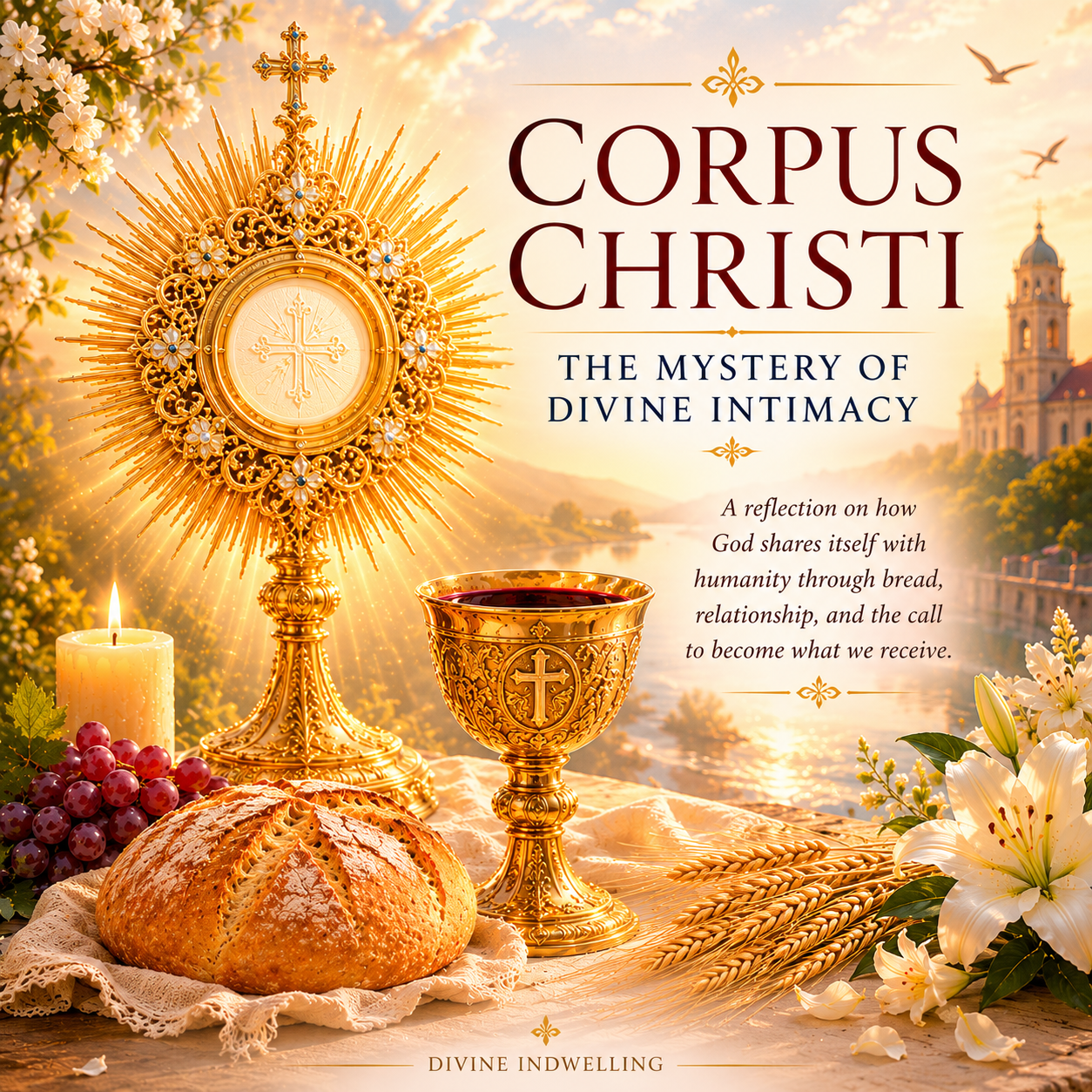
Corpus Christi and the mystery of divine intimacy
Article written with the help of ChatGPT
A universal spiritual question
Every spiritual tradition explores the relationship between the human being and the Divine. Across cultures and centuries, seekers, mystics, philosophers, and contemplatives have reflected on questions that arise naturally from the depths of the human heart.
How can God be known? How can God be experienced? How does divine presence touch human life? How does the Infinite share itself with the finite?
Different traditions express their answers through different languages and symbols.
Hinduism speaks of the relationship between Atman and Brahman.
Buddhism offers teachings on interbeing and the profound interconnectedness of all existence.
Sufism describes the longing of the lover and the Beloved.
Jewish mysticism speaks of the indwelling presence of the Shekhinah.
Christianity offers its own response through the mystery of the Eucharist.
The heart of Corpus Christi
The Feast of Corpus Christi celebrates the Christian conviction that divine love seeks complete communion with humanity.
It is a feast dedicated to contemplating the ways in which God shares divine life with human beings and invites them into an ever-deepening relationship of intimacy, participation, and transformation.
For many Christians, the bread and wine of the Eucharist become the primary symbols of this mystery.
For Catholics, they embody a reality that reaches beyond symbolism into the living presence of Christ. Beneath the theological language lies a profound spiritual insight that can be appreciated by people of many traditions: love seeks union.
Understanding divine intimacy
The mystery of Corpus Christi can be understood through experiences that belong to the universal human journey.
A parent loves a child with such depth that the lives of both become intertwined.
Two lovers grow into a relationship marked by shared presence and mutual devotion.
A musician becomes so immersed in music that performer and performance seem to move as one.
A meditator enters a depth of stillness where awareness rests within a larger field of presence and connection.
Corpus Christi points toward this movement of union. The feast celebrates the possibility of a relationship with God so intimate that divine life becomes woven into the fabric of human life.
Why bread?
One of the most beautiful aspects of this feast is the symbol through which this mystery is expressed. God chooses bread.
Bread nourishes life.
Bread gathers people around a table.
Bread is shared among families, friends, and communities.
Bread belongs to the rhythms of ordinary human existence.
Across cultures, it has served as a symbol of sustenance, hospitality, and relationship.
Many contemplatives have observed that divine wisdom often reveals itself through the ordinary realities of daily life. The sacred appears through simple acts of kindness, through moments of presence, through shared meals, through human relationships, and through the gifts that sustain life. The Eucharist continues this pattern. The mystery of divine communion is revealed through one of humanity's most familiar forms of nourishment.
The great exchange
Christian mystics have often described the Eucharist as a great exchange. Human beings receive God, and through that encounter they are gradually transformed. This transformation stands at the heart of the spiritual life.
St. Augustine expressed this beautifully when he wrote, "Become what you receive."
His insight points toward a universal spiritual principle. Human beings are shaped by what they take into themselves.
The thoughts we cultivate influence our perception of reality.
The stories we tell ourselves shape our identity.
The values we embrace become habits.
The qualities we admire gradually become qualities we embody.
Fear shapes the fearful heart. Anger shapes the angry heart. Wisdom shapes the wise heart. Compassion shapes the compassionate heart. Beauty, truth, and love leave their imprint upon the human soul.
The Eucharist expresses this principle through a sacred ritual. Christians receive Christ so that the life of Christ may become visible within them. Through participation in this mystery, believers seek to embody compassion, forgiveness, humility, generosity, courage, and love.
We become what nourishes us
Viewed through an interspiritual lens, Corpus Christi speaks to a truth recognized in many wisdom traditions: we become what we allow to nourish us.
The feast invites us to reflect on the influences that shape our lives and the qualities we cultivate within ourselves. Whatever we receive repeatedly into our minds, hearts, and actions gradually becomes part of who we are.
God in the material world
The feast also carries a uniquely Christian claim about the relationship between God and the material world.
Christianity teaches that God shares divine life through matter, through history, and through human experience.
The life of Jesus expresses this vision through the Incarnation, the belief that God entered human existence in a direct and transformative way.
The Eucharist extends this movement of divine self-giving through the elements of bread and wine.
Within this vision, creation becomes a vehicle of divine presence. Matter becomes capable of bearing spiritual meaning. Human life becomes a meeting place between heaven and earth. The sacred becomes woven into the ordinary realities of existence.
The invitation to communion
This understanding reflects a God who continually seeks relationship with humanity.
Divine love reaches toward creation with generosity and abundance.
Divine presence invites participation.
Divine life seeks expression within human lives, communities, and relationships.
At its deepest level, Corpus Christi explores the mystery of divine intimacy. The feast invites reflection on a love that seeks communion, a presence that seeks relationship, and a reality that continually offers itself to humanity.
A feast for every spiritual seeker
Different people may understand this mystery through different lenses. Some approach it through theology, others through symbolism, psychology, contemplation, or mystical experience. Beneath these diverse perspectives lies a question that has inspired spiritual seekers throughout history: How close is God to us?
Corpus Christi offers Christianity's response to that question. It presents a vision of divine love that continually moves toward humanity and invites human beings into participation in that love. The feast celebrates a relationship in which God shares divine life with creation and calls every person into a deeper experience of communion, presence, and transformation.
For this reason, Corpus Christi remains one of the most beautiful contemplations of the spiritual life. It invites us to recognize the sacred within the ordinary, to receive the gifts that nourish the heart, and to grow into an ever-greater embodiment of wisdom, compassion, and love. In doing so, it offers a vision of humanity living in conscious relationship with God and participating in the mystery of a love that continually seeks union.