Reflection 7: Rethinking Sin, A Path to Deeper Connection
Blessings, Pilgrims,
I hope the first week of teachings was meaningful for you. If you haven’t fully healed your relationship with God or found the right words for your experience, take heart, the spiritual journey isn’t a race. Healing unfolds in its own time, and every insight, every moment of reflection, is already a step forward. Be gentle with yourself. God meets us where we are, with patience and love.
Last week, we explored the God Wound and our image(s) of God, how they shape our relationship with the Divine. This week, we turn to:
Meeting & getting acquainted with God
Think of an old friendship rekindled or the joy of meeting someone who feels like home. After clearing past misunderstandings, the natural next step is to spend time together, deepening the relationship beyond ideas and assumptions.
Friendships flourish as we discover where and how to meet. Some connections thrive in nature, others over deep conversations, music, silence, or shared experiences. The same is true for our relationship with God:
Where does God delight in meeting us?
Where do we feel most alive in God’s presence?
The word sin is often the elephant in the room. Personally, it’s a word that makes me cringe because it carries so much weight: punishment, dogma, and a sense of unworthiness. For many, especially in Judeo-Christian traditions and the societies shaped by them, sin is the first lens through which people approach God. It’s a central theme in the scriptures of Abrahamic religions (Judaism, Christianity, and Islam), and for some, it can feel more like a barrier than a bridge to connection. That’s why it’s worth stepping back to re-examine it with fresh eyes.
Scriptures often emphasize human failings and the call to repentance. Messages like these are deeply embedded in religious consciousness:
"Repent, and you shall be saved."
"You must first acknowledge your sinfulness before approaching God."
"Without repentance, there can be no reconciliation with the Divine."
This language suggests that our primary identity before God is that of a sinner, estranged and in need of fixing before we can be worthy of divine love.
In everyday conversation, sin is often understood as a moral failing, wrongdoing, or offense, something "bad" that a person does, often with a sense of guilt or shame attached to it. When sin, as it is commonly understood, is the starting point, our relationship with God can become rooted in fear rather than trust. If we see God as keeping score, waiting for us to confess our failures before offering love, spirituality may feel more like guilt management than a life-giving connection. This can distort our perception of God and make it difficult to experience a relationship built on love, joy, and presence.
Since sin is a central theme in Abrahamic traditions, which have shaped much of the world’s spiritual and cultural landscape, it’s important that we take time to explore it. Today, we will begin reframing the concept of sin, moving from fear toward a deeper, healing relationship with the Divine.

Dictionary definition of sin
According to Merriam-Webster, sin is defined as:
An offense against religious or moral law
An action that is or is felt to be highly reprehensible (e.g., it’s a sin to waste food)
A serious shortcoming or fault
The Oxford English Dictionary (OED) defines sin as:
An immoral act considered to be a transgression against divine law
An act regarded as a serious offense or fault
Both definitions emphasize the moral and religious nature of sin, reinforcing the idea that it is an offense against a higher moral or divine order.

A call back into alignment
Sin is not just a theological concept; it has shaped entire cultures, influencing morality, justice systems, and how people see themselves and one another. It is a word that carries immense weight, shaping not only religious beliefs but also the very foundations of ethics and societal norms.
Different traditions define sin in various ways, some see it as breaking divine law, others as disrupting harmony, or as something that clouds our true nature. Yet, at its core, sin is not about permanent separation. But at its heart, across so many traditions, sin is not about separation. It is about a call back. A call back into alignment, into healing, into deeper relationship with God.
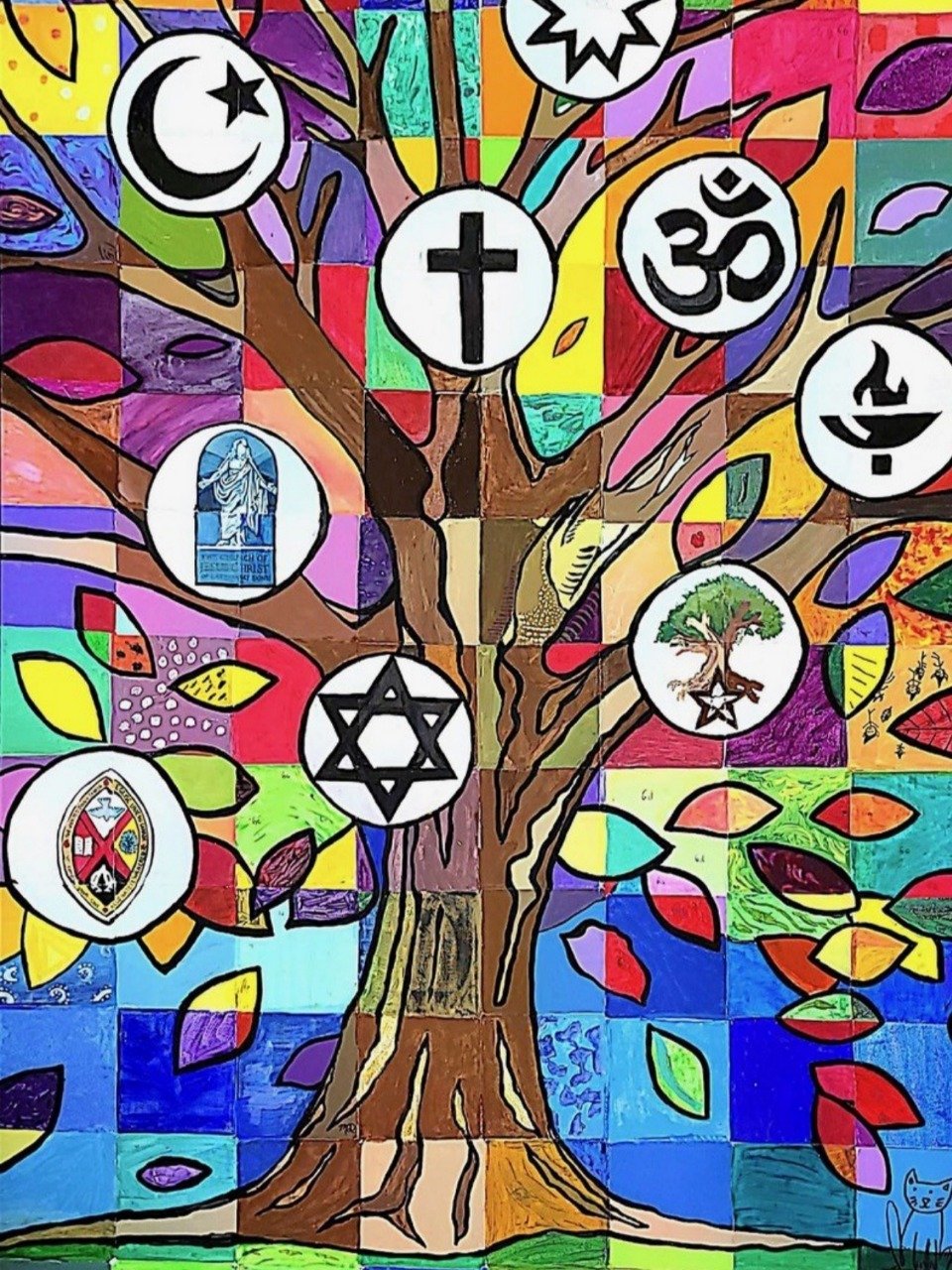
Sin across Faiths
Exploring the concept of sin across different faith traditions can open new pathways for understanding, both spiritually and personally. Each tradition offers a unique lens. By stepping outside the framework we may have inherited, we can begin to reframe sin in a way that feels less like a burden of shame and more like an invitation to transformation.
Interspirituality teaches us that wisdom is not confined to one tradition. By exploring how sin is understood across faiths, we not only deepen our personal relationship with the Divine but also cultivate a broader sense of connection with others. Understanding each other’s spiritual perspectives can help heal divisions and bring people together. As we open ourselves to these diverse perspectives, we may find a more life-giving way to approach our own struggles, one rooted in love, growth, and divine companionship.
Spiritual Assignment
Explore the drop-down menu below and take some time to reflect on the different ways sin is understood across various religious traditions. As you read, pay attention to both the differences and the common threads. Does a particular perspective resonate with you? Challenge you? Spark curiosity?
Now, take a moment to reflect on your own understanding of sin. How have you seen it in the past? And after exploring these perspectives, has your understanding shifted?
If you were to redefine sin in a way that deepens your connection with God—one rooted in love rather than guilt or fear—what would that new definition be?
-
In Christianity, sin is commonly understood as a transgression against God's will, creating a separation between humans and God.
The concept originates from the story of Adam and Eve in the Book of Genesis, where their disobedience (often called "Original Sin" in some Christian traditions) introduced sin into the world.
Christian theology teaches that sin can only be overcome through faith, repentance, and divine grace.
Understanding of sin:
The Bible often speaks of sin as an act of disobedience, rebellion, or moral failure.
Different Christian traditions interpret sin in various ways:
Catholicism distinguishes between venial sins (minor offenses) and mortal sins (serious transgressions that break one's relationship with God).
Protestantism generally teaches that salvation comes through faith alone (sola fide) and that sin can be overcome by God's grace.
Eastern Orthodoxy focuses on sin as a spiritual illness rather than legal guilt, emphasizing healing and transformation rather than punishment.
-
In Islam, sin (known as "harām" for actions that are forbidden, or "dhanb" for sin in general) is often understood as an act of disobedience to Allah's will.
While sin in Islam is not inherently seen as a complete separation from Allah, it does require repentance (tawbah) to restore the relationship.
Islam views sin (dhanb, ithm, khati’ah) as an act of disobedience to Allah but does not believe in Original Sin. All humans are born in a state of purity (fitrah). Sin arises when people knowingly violate God's guidance.
Types of sin:
Major sins (kabair): Such as idolatry (shirk), murder, and false testimony, which require sincere repentance
Minor sins (saghair): Everyday moral failings that can be forgiven through good deeds and sincere faith.
Repentance and mercy:
Islam strongly emphasizes Allah’s mercy, sincere repentance (tawbah) allows for the complete forgiveness of sins.
-
In Judaism, sin (often referred to as "chet" (חֵטְא), meaning "to miss the mark") is understood as an action that deviates from God's commandments and moral expectations. Rather than viewing sin as an inherent corruption, Judaism sees it as a failure to live up to one’s ethical responsibilities.
Understanding of sin:
The Torah and later Jewish texts categorize sin into different levels:
Chet (חֵטְא) – An unintentional misstep.
Avon (עָוֹן) – A willful wrongdoing motivated by desires or weakness.
Pesha (פֶּשַׁע) – A deliberate act of rebellion against God.
Unlike Christianity, Judaism does not emphasize original sin, humans are born with both a good inclination (yetzer hatov) and an evil inclination (yetzer hara), and sin is seen as a choice rather than an inherited condition.
-
Hinduism does not have a singular concept of sin but recognizes pāpa (wrong actions) that create negative karma, affecting one's spiritual progress and future rebirths.
Sources of sin: Actions that go against dharma (cosmic order), such as harming others, dishonesty, or selfishness.
Consequences: Rather than divine punishment, sin leads to karmic consequences. Bad actions result in suffering, either in this life or future lives through reincarnation (samsara).
Forgiveness and redemption: Sins can be purified through good deeds, devotion (bhakti), rituals, and self-discipline. Some Hindu traditions emphasize divine grace, while others stress self-effort in overcoming karma.
-
Buddhism does not have a concept of sin in the same way as Abrahamic religions. Instead, wrong actions (akusala) are seen as unwholesome behaviors that generate suffering and negative karma.
Sin is not about breaking divine law but about acting out of ignorance, attachment, or hatred.
Understanding of sin:
Rather than divine punishment, Buddhism focuses on cause and effect (karma), negative actions lead to suffering, while positive actions bring harmony.
The Five Precepts (not killing, stealing, lying, sexual misconduct, and intoxicants) provide a moral framework to avoid unwholesome actions.
In Mahayana Buddhism, compassion and repentance (kshama) help purify past karma.
Theravāda Buddhism emphasizes mindfulness and ethical conduct as a path to liberation (nirvana).
-
In Sikhism, sin is understood as self-centeredness (haumai), which leads to ignorance of the divine and moral wrongdoing.
Unlike in some other religions, sin is not an inescapable burden but a condition that can be overcome through devotion and righteous living.
Understanding of sin:
Sikh teachings emphasize that sin arises from attachment, greed, anger, lust, and pride (the "Five Thieves").
Naam Simran (meditation on God's name) and seva (selfless service) help purify the soul.
Forgiveness and transformation are always possible through sincere effort and devotion.
-
Taoism does not have a rigid concept of sin but speaks of disharmony with the Tao (the Way). Wrong actions create imbalance, leading to personal and social disharmony.
Understanding of sin:
Rather than a list of prohibitions, Taoism teaches that one should seek balance, simplicity, and acting in accordance with the flow of nature (wu wei).
Wrongdoing results from ignorance and excessive desires, not rebellion against a divine being.
Cultivating virtue (te) and harmony restores balance
-
Many Indigenous and animist traditions do not have a concept of sin as divine disobedience but see wrong actions as a disturbance in the natural and spiritual order.
Understanding of sin:
Moral failings often involve harming the community, disrespecting ancestors, or disrupting nature’s balance.
Restoration is achieved through rituals, offerings, and reconciliation with the community and spirits.